

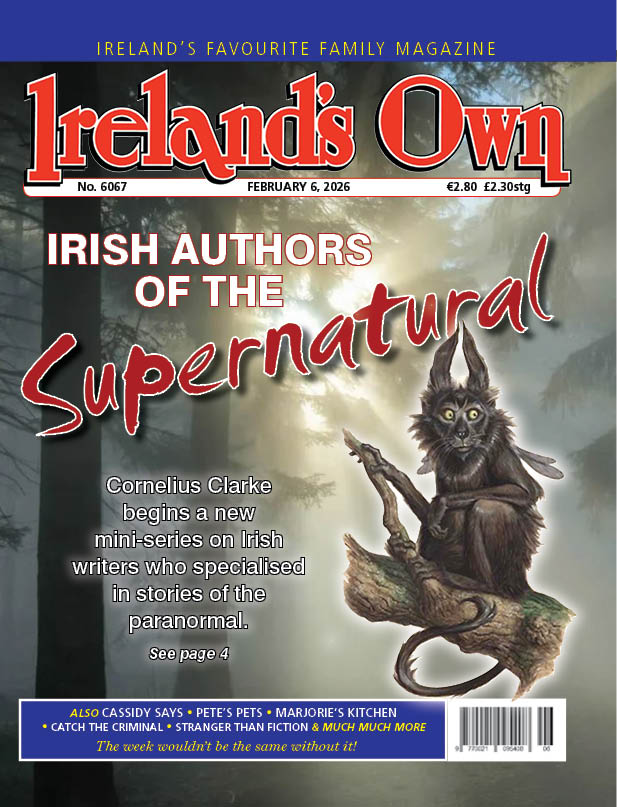
From the earliest of times Ireland has been a nation of storytellers, and it is in our psyche to be drawn to tales that send icy trickles down the spine. Cornelius Clarke begins a new mini-series on Irish writers who specialised in stories of the paranormal.
People like being scared; to be given a fright, even if it’s just for a short period of time. It starts in childhood. It could be argued that a game of Peek-a-Boo with a toddler is the earliest form of jumping out at someone, shouting BOO! When you think about it, a Jack-in-the-Box toy is essentially a ‘jump scare’. The child waits in anticipation, watching the lid of the box, while the parents turns the handle, which plays Half a pound of Tuppenny rice, until BANG the lids springs open and mad-faced Jack pops up! Terror is quickly followed by joy and calls for “Again!”
It continues throughout their childhood; it could be said that Hallowe’en, with its ghouls, witches and monsters, now belongs to children entirely. Many children’s authors have known this and continue to capitalise upon it. As they become adults, the thrill of a chill never goes away.
 Think of the people on a rollercoaster; their terror escalates as the coaster cranks slowly up the track, building the tension, then it reaches the top. Terror is now at its peak. The coaster starts to drop downward, building momentum until it is plummeting toward the earth, then zips and zooms, until finally it arrives back at the start. The people on the coaster scream, roar, terrified, fearful for their lives, and yet once back safely on the ground, they generally burst into fits of laughter, filled with a sense of achievement.
Psychologists have long acknowledged that fear is an important development in the human brain. A survival mechanism evolved over time by preparing our body to react to threats. It acts as a warning signal, alerting us of potential dangers and prompting us to take action, whether that is running or fighting.
As we experience fear, our bodies flush with hormones like adrenaline which increase our heart rate and energy levels, preparing us for whatever comes next. But fear is also a social shared experience, which helps bond people and provides a sense of liberation.
And so from earliest times, before the invention of radio, television and cinema and indeed, before the printing press, people would tell stories to one another. This continued even after the introduction and the explosion of new forms of media. In every playground, every pub, almost every social interaction, people will start telling stories and inevitably at some point, someone will tell a tale designed to send an icy trickle down the spine. Every person will attest to either experiencing a supernatural episode or know of someone who has. “I know a fella who is married to a woman whose mother told her this happened to her father” is a not uncommon beginning to most urban legends.
Since the beginning time, people would gather around the fire and tell stories and most likely than not, there was always a tale to send you off to sleep with a chill. Ghost stories, weird and mysterious tales are so popular that in 2024, the thriller genre accounted for over 27 percent of all book sales, second only to romance novels.
Writers reflect society and Irish authors have had a wealth of history and folklore to draw from. As a nation of people, the Irish love a ghost story. When I was very young, I remember watching Dave Allen on the TV and, in amongst his brilliantly crafted comedy monologues, he would tell a ghost story, which was both scary and more importantly – fun.
Continue reading in this week’s Ireland’s Own